




October 16, 2026
Reusable vs Disposable Gloves: Which Is Right for Your Industry?
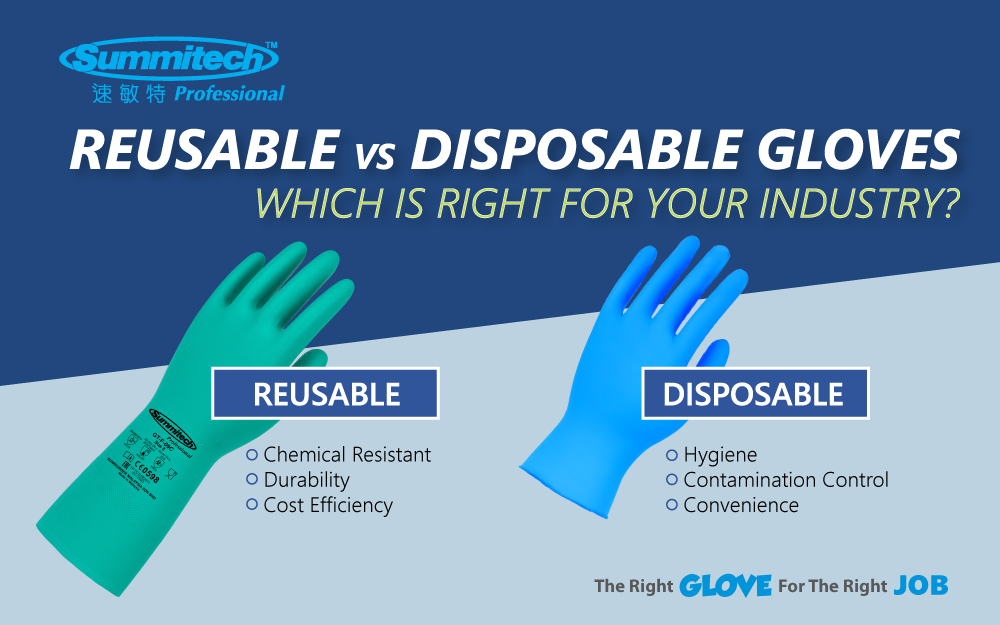
Reusable vs Disposable Gloves: Which Is Right for Your Industry?
A Practical Guide to Choosing the Right Glove for Safety, Cost, and Productivity
In industrial environments, glove selection directly impacts safety, cost efficiency, hygiene and operational productivity. One of the most common questions is:
Should we use reusable gloves or disposable gloves?
While both serve essential protective functions, they are designed for very different applications. Choosing incorrectly can lead to unnecessary expenses, reduced safety and operational inefficiencies.
At Sumirubber Malaysia, our Summitech Professional range includes both reusable and disposable glove solutions engineered for industrial performance. This article provides a comprehensive guide to help you determine which option best suits your industry.
Understanding Disposable Gloves
Disposable gloves are designed for single-use applications. They are typically thinner and intended to be discarded after contamination or task completion.
Common Materials:
- Nitrile
- Latex
- PVC
Key Characteristics:
- Lightweight and flexible
- High tactile sensitivity
- Quick and easy to replace
- Designed for short-duration tasks
When Disposable Gloves Are the Right Choice?
1. Hygiene-Critical Environments
Industries such as food processing, laboratories, healthcare support and electronics manufacturing rely heavily on disposable gloves to prevent cross-contamination.
Single-use policy ensures:
- Reduced transfer of contaminants
- Improved compliance with hygiene protocols
- Lower cleaning requirements
2. Frequent Glove Changes
If workers must change gloves multiple times per shift due to contamination risks, disposable gloves provide efficiency and convenience.
3. Precision Tasks
Thin disposable gloves allow better finger sensitivity, making them ideal for detailed assembly work or quality inspection.
Limitations of Disposable Gloves
While highly convenient, disposable gloves are not suitable for:
- Heavy-duty mechanical work
- Extended chemical immersion
- High abrasion environments
- Tasks involving sharp materials
In such cases, glove failure risk increases significantly.
Understanding Reusable Gloves
Reusable gloves are engineered for longer wear duration and higher durability. They are typically thicker and built to withstand mechanical, chemical or thermal stress.
Common Materials:
- Nitrile
- Natural rubber
- PVC
- Neoprene
Key Characteristics:
- Greater thickness and durability
- Higher resistance to chemicals and abrasion
- Designed for repeated use
- Suitable for demanding industrial applications
When Reusable Gloves Are the Right Choice?
1. Chemical Handling
Reusable chemical-resistant gloves provide better protection against permeation and degradation compared to thin disposable gloves.
2. Heavy-Duty Industrial Work
Industries such as:
- Manufacturing
- Automotive
- Oil & gas
- Maintenance
- Construction
require gloves that can withstand friction, pressure and mechanical stress.
3. Cost Efficiency Over Time
Although reusable gloves have a higher upfront cost, they are often more economical for applications that do not require constant disposal.
Cost Comparison: Short-Term vs Long-Term
|
Factor |
Disposable Gloves |
Reusable Gloves |
|
Initial Cost |
Lower per pair |
Higher per pair |
|
Replacement Frequency |
Very frequent |
Less frequent |
|
Durability |
Low |
High |
|
Protection Level |
Moderate |
High |
|
Best For |
Hygiene & short tasks |
Heavy-duty & extended tasks |
The key is to evaluate total cost of ownership, not just unit price.
Environmental Considerations
Sustainability is becoming increasingly important in industrial procurement decisions.
- Disposable gloves generate higher waste volume.
- Reusable gloves reduce disposal frequency but require proper maintenance.
Organizations aiming to reduce environmental impact often evaluate:
- Waste management costs
- Recycling capabilities
- Application suitability
Choosing the right glove for the right task helps reduce unnecessary waste.
Safety Risks of Choosing Incorrectly
Using disposable gloves for heavy-duty work may result in:
- Tears and punctures
- Chemical breakthrough
- Increased injury risk
Using reusable gloves in hygiene-critical environments without proper cleaning may result in:
- Cross-contamination
- Compliance violations
Correct selection is not just about cost — it is about risk management.
Decision Checklist: Ask These Questions
Before selecting gloves, consider:
- Is the task short-term or prolonged?
- Is contamination control a priority?
- Are any chemicals or harmful substances involved?
- Is abrasion or mechanical stress present?
- How frequently must gloves be changed?
- What is the compliance requirement?
These factors help determine the most suitable glove category for your application.
The Hybrid Approach: Many Industries Use Both
In reality, many operations use both reusable and disposable gloves:
- Disposable gloves for inspection and hygiene-sensitive areas
- Reusable gloves for chemical mixing, cleaning and heavy-duty tasks
A balanced glove strategy ensures both safety and operational efficiency.
Summitech Professional: Engineered for Performance
At Sumirubber Malaysia, our Summitech Professional glove range is developed to support diverse industrial needs, offering:
- Reliable chemical resistance
- Durable reusable solutions
- High-quality reusable options
- Application-specific design
We believe glove selection should be strategic — not reactive.
Final Thoughts
There is no universal answer to reusable vs disposable gloves. The right choice depends entirely on your application, risk level, and operational requirements.
By understanding the strengths and limitations of each type, businesses can:
- Improve workplace safety
- Control long-term costs
- Enhance productivity
- Maintain compliance standards
At Sumirubber Malaysia, we are committed to helping industries make informed hand protection decisions through trusted Summitech Professional solutions.
Recent Tips

October 12, 2026
Eco-Friendly Gloves: Are They the Future?
September 18, 2026
The Role of Gloves in Reducing Cross-Contamination