




October 12, 2026
Eco-Friendly Gloves: Are They the Future?
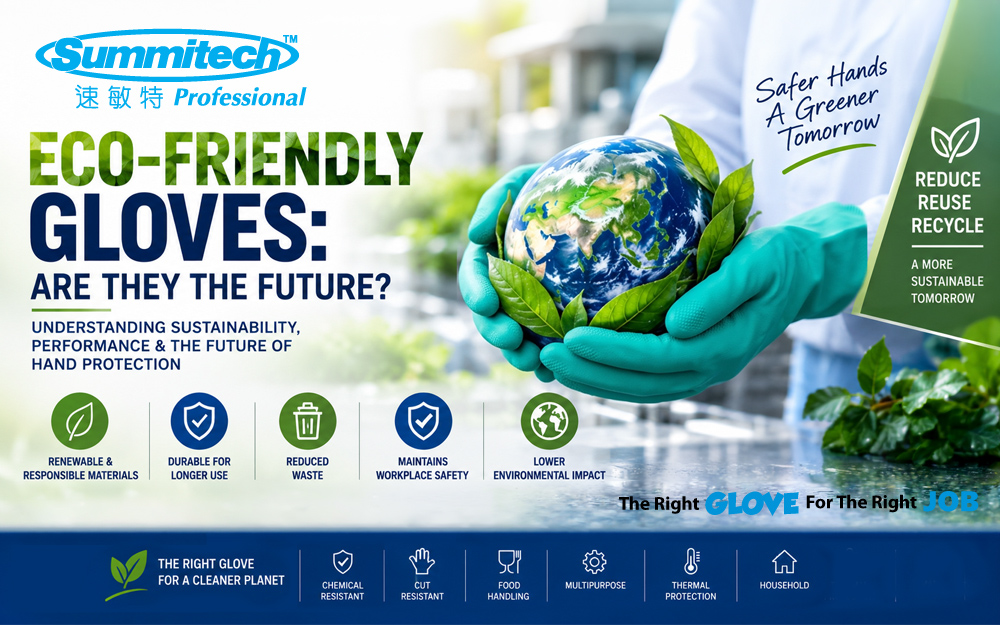
Eco-Friendly Gloves: Are They the Future?
Understanding Sustainability, Performance & the Future of Hand Protection
Sustainability is becoming an increasingly important consideration across industries. Companies are looking for ways to reduce waste, improve resource efficiency and make more responsible purchasing decisions — including when selecting personal protective equipment (PPE).
Gloves are essential for protecting workers from chemicals, cuts, heat, contamination and other workplace hazards. But with millions of disposable and reusable gloves used every day, an important question is emerging:
Can hand protection become more environmentally responsible without compromising worker safety?
The answer is not simply about choosing a glove labelled “eco-friendly.” Sustainable hand protection requires consideration of the glove's materials, manufacturing process, service life, usage, disposal and overall performance.
What Makes a Glove More Sustainable?
There is no single factor that determines whether a glove is environmentally friendly. Several aspects should be considered throughout the product lifecycle.
1. Material Selection
Traditional gloves are commonly manufactured from materials such as natural rubber, nitrile, PVC and other synthetic polymers.
Natural rubber is derived from renewable rubber trees, while synthetic materials such as nitrile are petroleum-based. However, material origin alone does not determine the overall environmental impact.
The manufacturing process, energy consumption, additives, transportation, durability and end-of-life treatment also contribute to a glove's environmental footprint.
Therefore, renewable material does not automatically mean sustainable and synthetic material does not automatically mean unsustainable.
2. Durability and Product Lifespan
One of the most practical ways to reduce glove waste is to use the right glove for the right application.
A glove that fails prematurely may need to be replaced more frequently, resulting in greater material consumption and waste.
For reusable gloves, durability can be particularly important. A glove that provides reliable protection through multiple work cycles may reduce the number of gloves required over its useful life.
However, durability should never come at the expense of safety. Gloves must always be replaced when they are damaged, degraded or no longer provide the intended protection.
3. Reducing Unnecessary Waste
Disposable gloves are essential for many applications, particularly where hygiene and contamination control are critical. Food processing, healthcare, laboratories and certain manufacturing processes may require frequent glove changes.
In these environments, reducing unnecessary glove changes should not mean extending glove use beyond its intended purpose.
Instead, businesses can focus on:
- Selecting the correct glove for the application
- Using the correct glove size
- Avoiding unnecessary glove damage
- Establishing appropriate glove-changing procedures
- Separating disposable and reusable glove applications
- Training workers on proper glove use
Waste reduction should always work together with safety and hygiene requirements.
Are Reusable Gloves More Environmentally Friendly?
Reusable gloves can potentially reduce the number of gloves consumed because they are designed for repeated use.
They are particularly suitable for applications such as:
- Chemical handling
- Cleaning and maintenance
- Industrial handling
- General manufacturing
- Heavy-duty applications
However, reusable gloves also require cleaning, water, energy and proper maintenance.
If a reusable glove is not cleaned correctly, it may become a contamination risk. If it is exposed to chemicals beyond its resistance capability, it may also degrade and require early replacement.
Therefore, the sustainability benefit depends on how the glove is selected, used, maintained and eventually replaced.
What About Biodegradable Gloves?
Biodegradable and compostable glove technologies are attracting increasing attention.
However, biodegradable does not necessarily mean that a glove will quickly decompose under normal environmental conditions.
Some materials require specific industrial composting or controlled conditions to break down effectively. If these facilities are unavailable, the expected environmental benefit may not be fully achieved.
For this reason, companies should look beyond marketing claims and consider:
- What material is the glove made from?
- Under what conditions does it biodegrade?
- Is it commercially compostable?
- What disposal facilities are available locally?
- Does the glove still provide the required protection?
- Is there reliable supporting documentation?
Sustainability claims should always be evaluated alongside performance and evidence.
Safety Must Come First
The most sustainable glove is not necessarily the glove with the lowest environmental impact on paper.
If a glove does not provide sufficient protection, workers may face injury, chemical exposure, contamination or other hazards. This can result in increased medical costs, lost productivity and additional PPE consumption.
The correct approach is therefore:
Safety first → Appropriate performance → Durability → Responsible resource use
Environmental considerations should strengthen PPE selection — not compromise worker protection.
The Importance of Proper Glove Selection
Choosing the right glove can contribute to both safety and sustainability.
Before selecting a glove, consider:
Hazard
What risks are workers exposed to?
Application
Will the glove be used for chemical handling, food processing, general handling, cutting, heat or another task?
Expected service life
Is the glove designed for single use or repeated use?
Durability
Can it withstand the mechanical, chemical or environmental conditions of the application?
Maintenance
If reusable, can it be properly cleaned, dried and stored?
End-of-life
How should the glove be disposed of after use?
A glove should be selected based on its total value and lifecycle, rather than simply its purchase price or environmental label.
How Manufacturers Can Support a More Sustainable Future
Glove manufacturers have an important role to play in developing more sustainable PPE.
Future developments may include:
- Greater use of responsibly sourced materials
- More efficient manufacturing processes
- Reduced material consumption without sacrificing protection
- Longer-lasting reusable glove designs
- Improved packaging efficiency
- Better product lifecycle information
- Development of lower-impact materials
- More responsible waste-management solutions
The industry is moving toward a more complete understanding of sustainability — from raw materials through manufacturing, use and disposal.
The Role of Summitech Professional
At Summitech Professional, hand protection is centred on providing the right balance between protection, performance, comfort and value.
Sustainability should not be viewed as a separate consideration from glove performance. Selecting the appropriate glove, using it correctly and replacing it only when necessary, can all contribute to more responsible PPE consumption.
For industrial users, the goal is not simply to use fewer gloves. It is to use the right gloves, for the right application, in the right way.
A Practical Sustainability Checklist
Before purchasing or using gloves, ask:
✓ Is this glove suitable for the actual workplace hazard?
✓ Is the glove designed for single use or repeated use?
✓ Can the glove provide the required service life?
✓ Are workers using the correct size and type?
✓ Can reusable gloves be properly cleaned and maintained?
✓ Are gloves being replaced because they are damaged — or simply out of habit?
✓ Does the manufacturer provide reliable information about materials and environmental claims?
✓ Is the disposal method appropriate for the glove and application?
Final Thoughts
The future of sustainable hand protection is unlikely to be based on one “perfect” eco-friendly glove.
Instead, it will come from a combination of better materials, smarter manufacturing, longer product life, responsible usage, reduced waste and appropriate disposal.
Most importantly, sustainability should never come at the expense of worker protection.
The future is not simply about using greener gloves.
It is about making better glove choices — protecting people while using resources more responsibly.
Recent Tips

September 18, 2026
The Role of Gloves in Reducing Cross-Contamination