




October 05, 2026
Glove Thickness Explained: Finding the Right Balance Between Protection and Dexterity
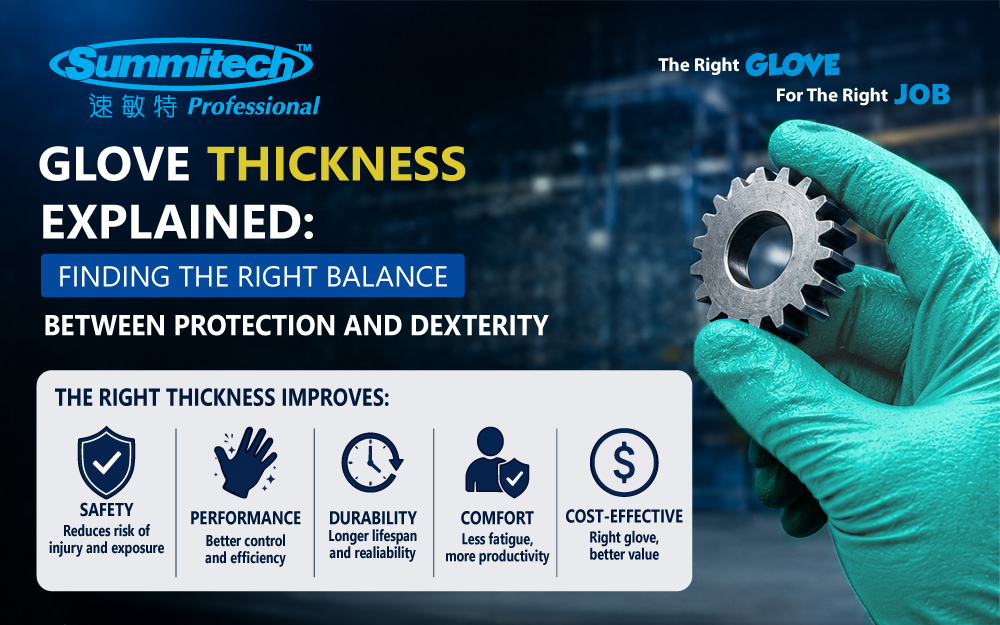
Glove Thickness Explained: Finding the Right Balance Between Protection and Dexterity
When selecting industrial gloves, one of the first specifications buyers often compare is glove thickness. It is easy to assume that thicker gloves always provide better protection, while thinner gloves are less effective. However, the reality is far more nuanced.
Glove thickness directly affects protection, flexibility, comfort, grip, durability and productivity. Choosing the thickest glove available may actually reduce worker efficiency, while selecting a glove that is too thin may expose workers to unnecessary risks.
At Sumirubber Malaysia, we believe the best glove is not simply the thickest—it is the glove that provides the right balance between protection and performance for the task at hand.
What Does Glove Thickness Mean?
Glove thickness refers to the distance between the inner and outer surfaces of the glove material. It is commonly measured in:
- Millimetres (mm)
- Mils (1 mil = 0.001 inch ≈ 0.0254 mm)
For example:
- 8 mil = approximately 0.20 mm
- 15 mil = approximately 0.38 mm
- 22 mil = approximately 0.56 mm
While thickness is an important specification, it should never be the only factor considered during glove selection.
How Thickness Affects Protection
Generally, thicker gloves provide greater resistance to:
- Chemical permeation
- Abrasion
- Cuts and punctures
- Wear from repeated handling
A thicker material creates a longer path for hazardous substances or sharp objects to penetrate.
However, protection depends not only on thickness but also on:
- Glove material
- Manufacturing quality
- Surface coating
- Intended application
For example, a high-quality nitrile glove may outperform a thicker natural rubber glove against certain chemicals.
How Thickness Affects Dexterity
Dexterity refers to a worker's ability to perform precise hand movements.
As glove thickness increases:
- Finger sensitivity decreases
- Small object handling becomes more difficult
- Precision work requires more effort
For industries such as electronics assembly, laboratory work, quality inspection or food preparation, maintaining dexterity is often just as important as protection.
A glove that limits finger movement can reduce productivity and increase operator fatigue.
Comfort Matters More Than Many People Realize
Workers often wear gloves for several hours each day.
If gloves are excessively thick, they may:
- Feel heavy
- Restrict natural hand movement
- Increase muscle fatigue
- Reduce worker acceptance
Conversely, gloves that are too thin may wear out quickly or fail to provide adequate protection.
The ideal glove should allow workers to perform their tasks comfortably throughout an entire shift.
Matching Thickness to the Application
Different industries require different levels of protection.
Light-Duty Tasks
Applications include:
- Product inspection
- Assembly work
- Packaging
- Food preparation
Priority:
- Excellent dexterity
- High touch sensitivity
- Lightweight comfort
Generally, thinner gloves are preferred.
Medium-Duty Tasks
Applications include:
- General maintenance
- Equipment servicing
- Warehouse operations
- Cleaning
Priority:
- Balanced protection
- Good grip
- Moderate flexibility
Medium-thickness gloves often provide the best compromise.
Heavy-Duty Tasks
Applications include:
- Chemical handling
- Industrial cleaning
- Automotive maintenance
- Petrochemical operations
- Heavy manufacturing
Priority:
- Maximum durability
- Chemical resistance
- Abrasion protection
Thicker reusable gloves are generally recommended.
Thicker Does Not Always Mean Safer
One common misconception is that choosing the thickest glove automatically provides the highest level of safety.
In reality, an overly thick glove can:
- Reduce grip performance
- Increase the likelihood of dropping tools
- Cause hand fatigue
- Workers remove gloves during work
A glove that workers are unwilling to wear consistently offers little real-world protection.
Effective PPE should encourage continuous use through both comfort and performance.
The Relationship Between Thickness and Chemical Resistance
Many users assume thicker gloves automatically offer better chemical protection.
While thickness can increase breakthrough time, chemical resistance primarily depends on:
- Glove material
- Chemical compatibility
- Exposure duration
- Temperature
- Chemical concentration
For example:
A thinner nitrile glove may resist oils and solvents far better than a thicker latex glove.
This is why consulting chemical compatibility data is always recommended.
Finding the Right Balance
When selecting gloves, consider the following questions:
- What hazards are present?
- Is chemical protection required?
- Will workers handle small parts?
- How long will gloves be worn?
- Is comfort important for productivity?
- Does the task involve repetitive movement?
Answering these questions helps identify the optimal balance between protection and dexterity.
How Summitech Professional Gloves Deliver Balanced Performance
At Sumirubber Malaysia, every Summitech Professional glove is developed with application-specific performance in mind.
Our product range includes gloves designed for:
- Precision handling
- Chemical protection
- Heavy-duty industrial work
- Food processing
- Maintenance operations
Rather than offering a "one-size-fits-all" solution, we engineer gloves with carefully selected thicknesses that provide the right combination of:
- Protection
- Comfort
- Grip
- Flexibility
- Durability
This ensures workers remain both safe and productive throughout their shift.
Final Thoughts
Glove thickness is an important consideration, but it should never be viewed in isolation.
The safest glove is not necessarily the thickest—it is the one that delivers the appropriate level of protection while allowing workers to perform their tasks efficiently and comfortably.
By understanding the relationship between thickness, dexterity and application requirements, companies can make better purchasing decisions, improve PPE compliance, and enhance workplace safety.
At Sumirubber Malaysia, we are committed to helping industries select the right glove for the right job through trusted Summitech Professional solutions that combine safety, comfort and performance.
Recent Tips

September 18, 2026
The Role of Gloves in Reducing Cross-Contamination
August 10, 2026
Why Blue Gloves Dominate Food Processing